
What is Web 3 Crypto? Surviving EU Regulation Website Accessibility & Why "PayPal is Scam"
Asking what is web 3 or web 3 crypto? Learn how to escape the EU regulation website accessibility trap, achieve digital sovereignty, and see why "paypal is scam" trends.
Lab Invisible 1
4/27/20265 min read
What is Web 3 Crypto? Surviving EU Regulation Website Accessibility & Why "PayPal is Scam" Trends
Executive Summary: The internet was built as an escape hatch. Today, it is a high-security prison. If you are asking what is web 3, the answer is survival. Under the guise of consumer safety, laws regarding eu regulation website accessibility are creating a digital dystopia, pushing mandates that kill independent creators. Meanwhile, legacy banking cartels weaponize your money, explaining exactly why searches for paypal is scam hit all-time highs when accounts are frozen without trial.
There is only one exit door: the web 3 crypto ecosystem. This intelligence report breaks down the financial chokehold, the regulatory trojan horses, and how a decentralized internet is the only viable countermeasure.
The Regulatory Trojan Horse (Compliance as a Weapon)
The most effective way to kill freedom is to convince the public it is for their own safety. The European Union has mastered this. Through legislation like the Digital Services Act (DSA), the Digital Markets Act (DMA), and the European Accessibility Act (EAA), the EU has fundamentally altered the architecture of the internet from a permissionless frontier to a permissioned checkpoint.
The Moat of Bureaucracy
Regulations are rarely about protecting the user; they are about protecting the monopolies. Massive corporations like Google and Meta can afford armies of compliance lawyers to navigate EU directives. A solo developer or a startup cannot.
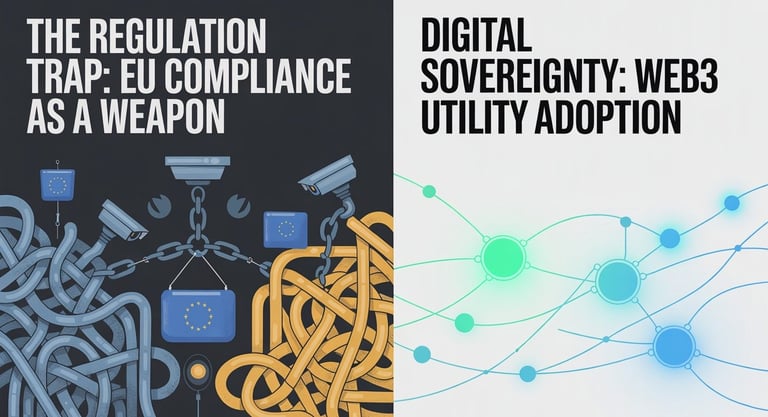
Take a close look at the incoming eu regulation website accessibility mandates. On paper, ensuring websites are usable by everyone is an undeniable net positive. In execution, the EU has weaponized compliance. By mandating labyrinthine technical requirements backed by crippling, business-ending fines, the EU effectively creates a financial moat. Independent creators, open-source developers, and small e-commerce operators will be forced to shut down or merge with massive, compliant platform ecosystems (like Shopify or Amazon) just to survive.
Regulation does not kill the giants. It kills the independent alternatives. It forces total centralization. And centralization is the prerequisite for surveillance.
The KYC Panopticon
Under the upcoming eIDAS 2.0 (Electronic Identification, Authentication and Trust Services), the EU is pushing toward a unified digital identity wallet. This is the death of anonymity. When your browser, your bank, your social media, and your government ID are permanently linked, dissent becomes impossible. You are no longer a citizen of the internet; you are a monitored node in a localized database.
The Financial Chokehold (The Legacy Bank Cartel)
Data surveillance is only half of the dystopia. The other half is financial control. The traditional banking system no longer serves the user; it serves as a geopolitical enforcement arm.
We have entered an era of arbitrary financial censorship. You do not own the money in your bank account; you have an IOU that the institution allows you to use, provided you do not violate their opaque, constantly changing Terms of Service.
The Illusion of Digital Money
Look at the dominant fintech platforms. It is not a coincidence that global search volume for queries like paypal is scam frequently spikes. Users are waking up to the reality of custodial finance. When a platform can freeze your assets for 180 days without a trial, reverse transactions based on internal political bias, or fine you directly from your balance for "acceptable use" violations, it ceases to be a payment processor. It becomes a financial dictator.
The banking institutions actively collude with regulatory bodies to ensure you cannot hold your own wealth. They restrict transfers to cryptocurrency exchanges, block wires to independent creators, and flag "unusual" legal purchases. They are paving the way for CBDCs (Central Bank Digital Currencies)—programmable money that can be geographically restricted, assigned an expiration date, or turned off entirely if your social or carbon compliance score drops.
Legacy finance is a cage. Web3 is the bolt cutter.
What is Web 3? (The Architecture of Defiance)
To understand the escape route, you must strip away the marketing garbage. Web3 has been hijacked by venture capitalists selling overpriced JPEG monkeys and vaporware casinos. That is not Web3. That is a distraction.
So, what is web 3 at its core? It is a verifiable, decentralized backend for the internet.
Web1 (Read-Only): Decentralized, but static. You consumed data.
Web2 (Read-Write): Dynamic, but centralized. You created data, but corporations owned it, monetized it, and censored it.
Web3 (Read-Write-Own): Dynamic and decentralized. You create data, and you own the cryptographic keys to it.
Web3 is the un-censorable infrastructure layer. It replaces trusting a corporation (like Amazon Web Services or Google Cloud) with trusting open-source mathematics.
If the EU wants to take down a website in Web2, they send a subpoena to a centralized server host, and the site vanishes. In a true Web3 architecture, there is no central server to subpoena. The data is distributed across a globally incentivized node network.
The Hardware Backbone
Real Web3 is not built on hype; it is built on utility. It requires decentralized storage and decentralized compute. Protocols like Arweave (permanent, immutable data storage), Filecoin (decentralized market for hard drive space), and ICP (Internet Computer Protocol for decentralized server compute) are the actual foundations of digital sovereignty. When you host a site on Arweave, no EU regulatory body can pull the plug, because the plug does not exist.
The Web 3 Crypto Ecosystem (Replacing the Cartel)
Cryptocurrency was not invented to make day traders rich. It was invented to separate money from the state.
The web 3 crypto ecosystem provides the native financial layer for the decentralized internet. It is permissionless. To open a bank account in the EU, you need a passport, proof of address, and a biometric scan. To open a Web3 wallet, you just need to generate a mathematical seed phrase.
The Regulation Trap (How We Lose)
Web3 is the cure, but the patient is actively swallowing poison. The EU knows that decentralized infrastructure is a threat to their control grid, and they have launched their counter-attack: MiCA (Markets in Crypto-Assets).
This is the regulation trap. MiCA is designed to force decentralized systems to behave like centralized banks.
The Co-option of Crypto
The regulators cannot shut down Bitcoin or Arweave. The math is immune to legislation. So, they attack the on-ramps and the developers.
The KYC Contagion: The EU is attempting to mandate that unhosted, private crypto wallets must be tracked by centralized exchanges. They want to attach a government identity to every decentralized address.
The Centralization Push: Venture-capital-backed "Web3" companies are willingly complying, building backdoors into their protocols to appease regulators.
If Web3 adopts the compliance standards of Web2, it is no longer Web3. It is just Web2 with a slower database.
How to Avoid the Trap
We do not ask for permission. We build parallel systems.
Prioritize Privacy Coins and Mixers: Total financial transparency is a dystopian nightmare. On-chain privacy is a human right.
Support Pure Utility: Ignore the casino tokens. Allocate resources to decentralized infrastructure—storage, compute, and bandwidth networks that actually replace AWS and Google Cloud.
Strict Self-Custody: If your crypto is on a centralized exchange (like Binance or Coinbase), you do not own Web3 crypto. You own a Web2 IOU. Pull it offline.
Lab Verdict: The Exit is Open, But Narrowing
The European Union is constructing a digital cage, painted with the comforting colors of "safety" and "compliance." Legacy banks are holding the keys, ready to lock you out of your own life the moment you become inconvenient.
Do not wait for the grid to close. Stop treating Web3 as a speculative casino and start treating it as a survival tool. Move your assets to self-custody. Move your data to decentralized storage. Adopt privacy protocols.
Digital sovereignty is no longer a luxury. In 2026, it is a necessity. Stay hidden.